
Organic grass seed mixtures
Organic grass seed mixtures in detail
When you opt for a regenerative or organic approach in your pasture or garden, the composition of your grass seed mixture plays a crucial role. Not all grass is the same, and certainly not every mixture is suitable for every purpose or every soil. In nature, grasses, clovers, and herbs do not grow randomly; together, they form a balance that adapts to the climate, soil conditions, stress, and the needs of the animals that graze on them. With this knowledge as our starting point, we have compiled various mixtures, each with its own function, balance, and added value.
Why different organic grass seed mixtures?
Most standard grass seed mixtures are designed for maximum yield, not for health. They often contain a significant proportion of perennial ryegrass and other fast-growing production grasses. These thrive on artificial fertilizers and intensive use but provide little structure, root superficially, and lack depth, both literally and figuratively.
Our organic grass seed mixtures are different. They are developed from the idea that grassland should not only fill but also nourish, care for, restore, and connect. This means:
- A healthy balance between fast and slow growers.
- Deep-rooting species that bring minerals from deeper layers to the surface.
- Structure-rich grasses that contribute to a healthy gut flora.
- Natural nitrogen fixers like clover, but in moderation, especially for animals on a sparse diet.
We will show them one by one.

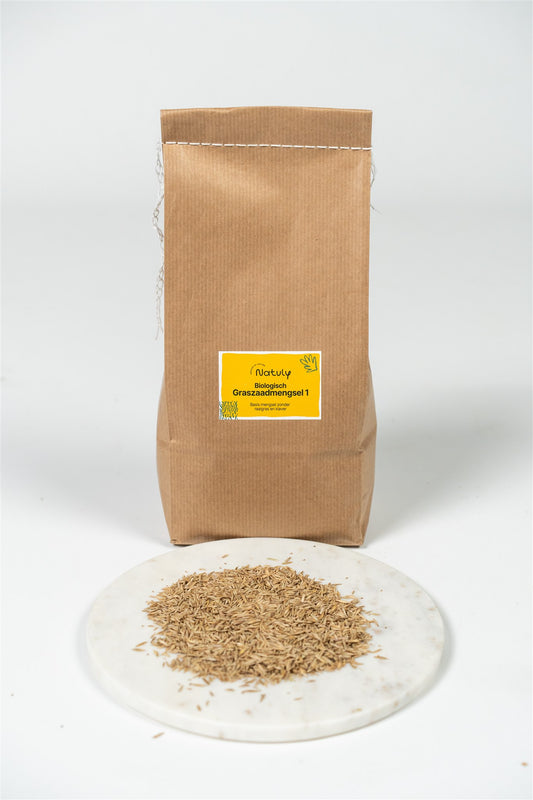
Mixture 1: Organic grass seed for balance and structure (without ryegrass and clover)
This mixture is an excellent basis for a natural (horse) pasture or for overseeding in pastures already rich in ryegrass or clover. By omitting these two commonly used species, sparse, structure-rich grasses are given ample space. The result? A calm, fiber-rich pasture that suits the digestive system of horses and other grazers.
Composition:
35% Timothy
25% Red Fescue
15% Cocksfoot
25% Meadow Fescue
Application:
This mixture is the basis for new sowing or as a corrective mixture for overseeding in existing pastures already rich in ryegrasses or clovers. Suitable for all soil types. Combine with mixture 3 or 4 (depending on the soil type) for extra biodiversity.
Sowing advice:
New sowing: 40 to 60 kg per hectare
Overseeding: 20 to 30 kg per hectare (repeat if necessary)
Mixture 2: Organic grass seed for productive animals (rich in clover)
With a higher proportion of clovers (approx. 20%), this mixture is primarily intended for productive animals such as young cattle, dairy cattle, or active horses with limited grazing. It is rich in energy and natural nitrogen fixers, but therefore often too rich for animals on a sparse diet.
Composition:
6 grass species:
20% Timothy
15% Meadow Fescue
20% Festulolium
5% Tall Fescue
15% Ryegrass
5% Cocksfoot
3 clover species:
10% Red Clover
3% White Clover
7% Berseem Clover (annual)
Application:
Not suitable as a main mixture for animals on a sparse diet. For horses, it is better to mix with mixture 1 and possibly 4.
Sowing advice:
New sowing: 40 to 50 kg per hectare
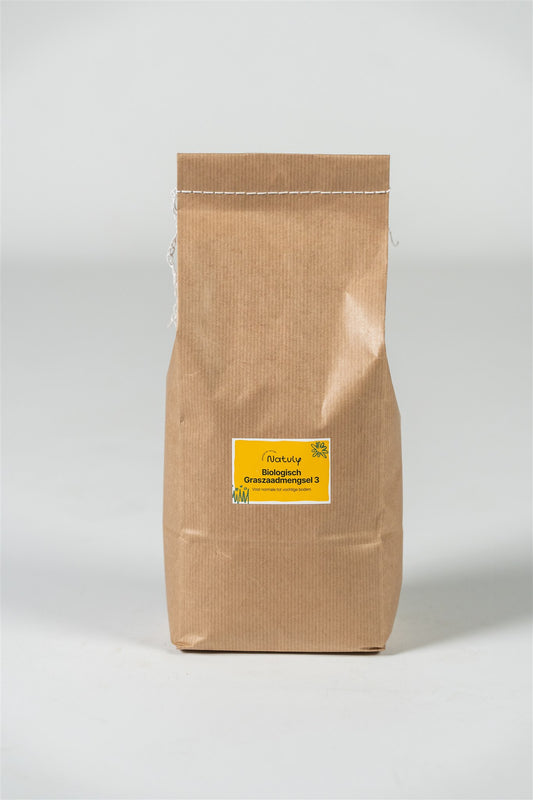
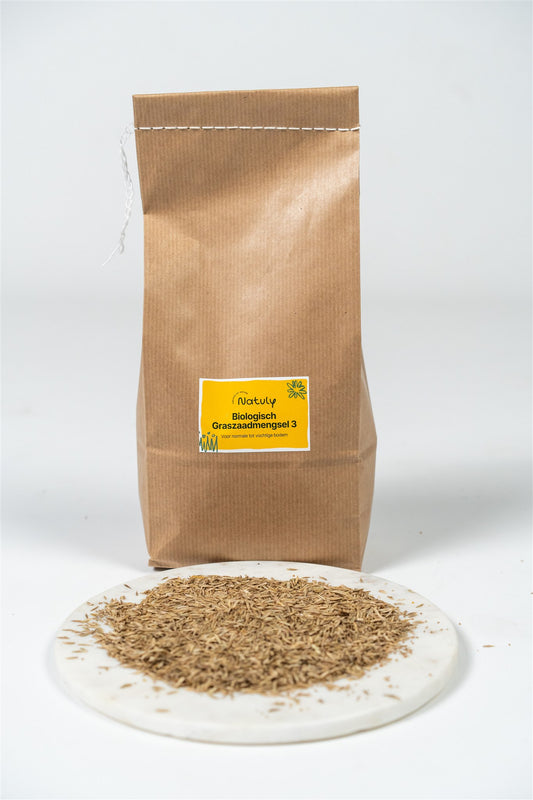
Mixture 3: Organic grass seed for normal to moist soils
A versatile mixture that performs well on average to somewhat wetter soils. It contains both structure-rich grasses and a small proportion of clover (2%) for natural nitrogen fixation without becoming too rich.
Composition:
30% Timothy
20% Meadow Fescue
20% Red Fescue
18% Perennial Ryegrass
10% Festulolium
1% White Clover
1% Red Clover
Application:
Choose grass seed mixture 1 as a base and mix with mixture 3 for moister soils for greater diversity in grasses.
Sowing advice:
New sowing: 40 to 60 kg per hectare
Overseeding: 20 to 30 kg per hectare
Mixture 4: Organic grass seed for drier soils
A robust mixture specifically developed for plots with drier or poorer soil. The carefully selected grass species are deep-rooting, drought-tolerant, and provide sufficient structure and palatability for grazers. Thanks to the mix of species, a resilient grassland is created that also withstands dry conditions without sacrificing nutritional value.
Composition:
25% Timothy
19% Red Fescue
15% Cocksfoot
15% Meadow Fescue
14% Ryegrass
10% Tall Fescue
1% White Clover
1% Red Clover
Application:
Suitable for dry, sandy, or extensively used plots. Choose grass seed mixture 1 as a base and mix with mixture 3 for greater diversity in grasses.
Sowing advice:
New sowing: 40 to 60 kg per hectare
Overseeding: 20 to 30 kg per hectare
Choose consciously: grass seed mixture as a basis for biodiversity
Whichever Natuly (formerly Bio-Ron) grass seed mixture you choose, our organic mixtures contribute to balance in the pasture. Not just in the short term, but especially in building a stable, nutritious, and biodiverse pasture. By consciously selecting species that suit the soil, the animals, and the purpose of the plot, you work towards a system that can sustain itself, without artificial interventions, but with confidence in the natural coherence of soil, plant, and animal.
Don't forget to consider the soil. Because what grows on it is linked to the balance in the soil. This creates nutritious soil, a diverse pasture, and a stable basis for everything that grows, blossoms, and grazes there.

Flowers and herbs
Grass seeds
-
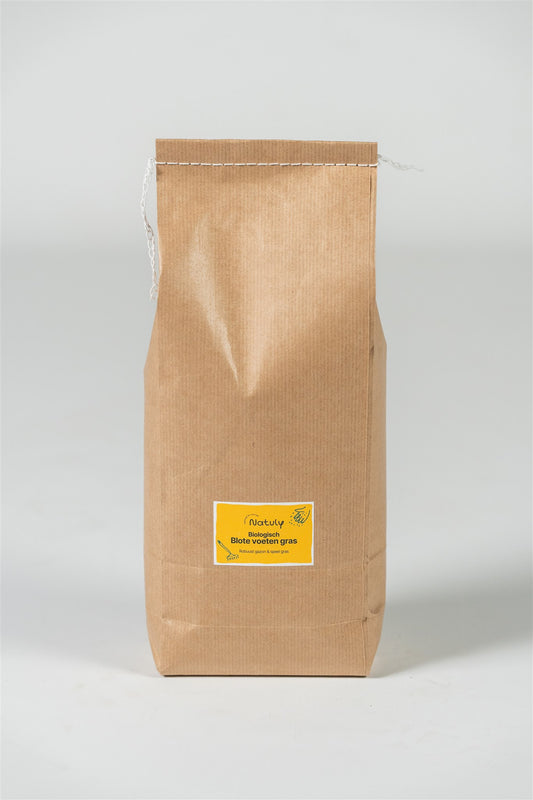
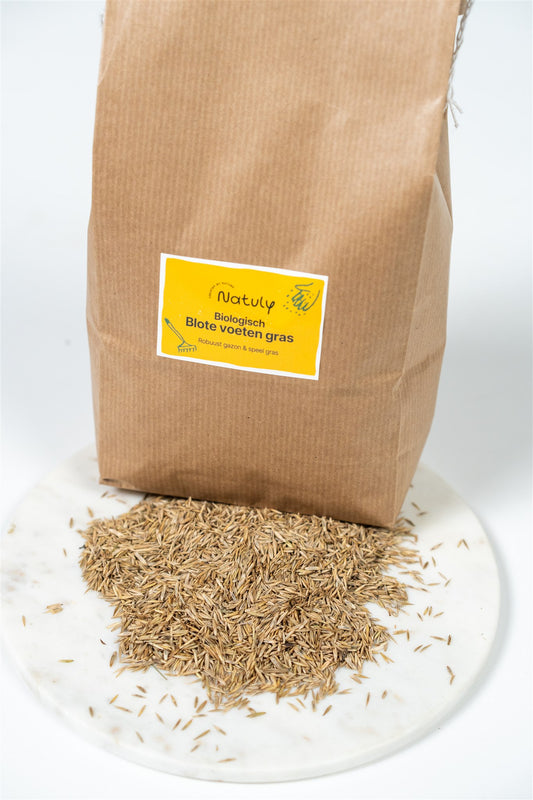
Barefoot Play & Lawn Grass
Regular price From €17,50Regular priceUnit price per -
Organic grass seed mixture 1
Regular price From €14,50Regular priceUnit price per -
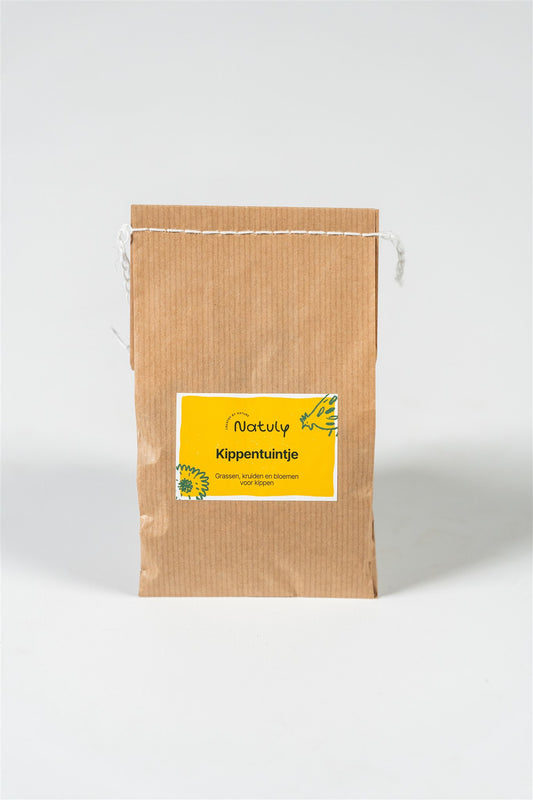
Chicken garden seed mix
Regular price From €9,95Regular priceUnit price per -
Organic grass seed mixture 3
Regular price From €14,96Regular priceUnit price per